
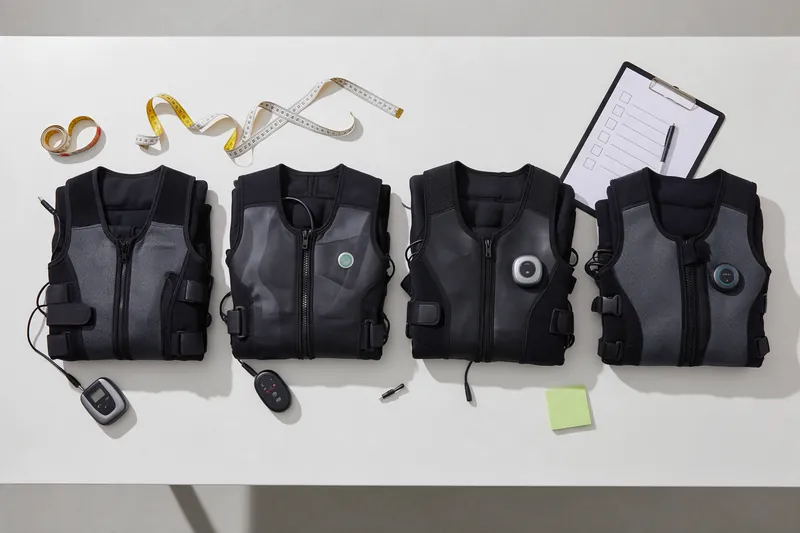
1. Cables
Studio consoles are often cabled. Home suits use a battery box with Bluetooth. Truly cable-free systems, where the box docks directly to the suit, give you the most freedom to move. Ask about Bluetooth stability and battery life, because both are real-world failure points.
2. Wet or dry electrodes
Wet systems need spraying and usually a base layer. Dry electrodes work on bare skin. Dry is faster and more pleasant. There is no independent trial showing better results from either. More in wet vs dry electrodes.
3. Channels, not just electrodes
Channels decide how finely you can set each muscle group. Check how many there are, whether calves, inner thighs and arms are covered, and whether left and right can be set separately. In the home group, published channel counts range from 10 to 13. Several brands publish none.
4. Published parameters
The research standard is 85 Hz at 350 microseconds.[1] A suit should publish a frequency and pulse-width range that includes those values. If the numbers are missing from the website, look for the FDA 510(k) summary, where they must be stated.
5. App and platform
Check iOS and Android support, whether you can adjust each channel during a session, whether there are beginner programmes, and whether any function sits behind a subscription. Guided classes help motivation. Manual control helps precision.
6. Safety features
Look for intensity limits for home users, an easy emergency stop, and onboarding that follows the expert guideline of one session a week at the start.[2] Be cautious if a brand tells you to train three or four times a week.
7. Washing and durability
Machine washing is the practical standard. Ask how many wash cycles the warranty covers and what a replacement suit costs. The suit is the wear part of every system.
8. Certification you can check
Ask for the FDA 510(k) number and look it up. See our list of verified clearances. Treat “FDA approved” as a red flag, because no EMS suit is approved.
9. Total cost over three years
Add the purchase price, any subscription, replacement suits and return fees. A $1,299 kit with a $49 monthly plan costs more than a $1,890 suit with none. We did the sums in the cost guide.
And one thing no spec sheet shows
How the impulse feels on your body. If you can, try a session before you buy, and check the return terms if you cannot. Restocking fees range from nothing to $450.
Frequently asked questions
How many channels should an EMS suit have?
Enough to set each major muscle group separately. Among home suits that publish the figure, the range is 10 to 13 channels.
Are cheap EMS suits safe?
Low-cost suits rarely publish parameters or certification, so you cannot verify their safety. Prefer a suit with an FDA 510(k) number you can look up.
Sources
- Kemmler W, et al. (2016). Effects of whole-body electromyostimulation versus high-intensity resistance exercise on body composition and strength: a randomized controlled study. Evidence-Based Complementary and Alternative Medicine 2016:9236809 – doi.org/10.1155/2016/9236809
- Kemmler W, et al. (2023). Position statement and updated international guideline for safe and effective whole-body electromyostimulation training. Frontiers in Physiology 14:1174103 – doi.org/10.3389/fphys.2023.1174103