
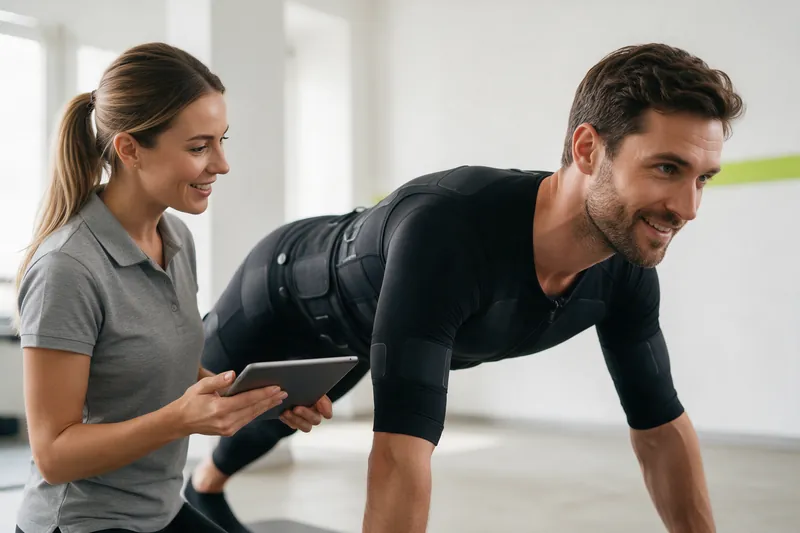
Muscle and strength: the best-supported effect
A 2021 meta-analysis of 16 studies with 897 non-athletic adults found large effects on muscle mass (standardised mean difference 1.23) and on leg and trunk strength (0.98 and 1.08). The effect on body fat was not significant.[1] A second meta-analysis in 2023, covering 26 randomised trials and 1,183 people, found smaller effects: 0.36 for muscle mass and 0.54 for strength.[2] Both reviews limit their conclusions to untrained, middle-aged or older people.
EMS against conventional training
In a 16-week trial of 48 untrained men, whole-body EMS and high-intensity resistance training produced similar gains in lean mass and leg strength, with no significant difference between groups. EMS took about 30 minutes a week, the gym about 61. The authors called EMS a “time-efficient but pricy option”.[3]
A 2025 trial in 46 active adults compared 25 minutes of EMS with 90 minutes of resistance training, twice a week for 20 weeks. Both groups improved. Resistance training produced greater strength gains and fat loss. The authors see EMS as a “viable alternative for individuals unable to engage in high-load resistance training”.[4]
Athletes and active people
A review of 89 trials, mostly of local EMS, found gains in strength, jumping and sprinting within 3 to 6 weeks, including in elite athletes.[5] For whole-body EMS specifically, a 2024 systematic review concluded that it “does not offer superior training adaptations compared to other training methods in active populations”.[6]
Chronic low back pain
In a trial of 110 patients, pain fell by 22.3% with weekly EMS and by 30.2% with conventional back training, with no significant difference between them.[7] A three-arm trial of 240 patients found about 30% pain reduction with EMS, whole-body vibration and conventional training alike, with 43 to 62% less training time in the EMS group.[8]
Older adults
In women of about 75, a year of EMS raised appendicular muscle mass by 0.4% while it fell 1.5% in controls, and leg strength rose 9.8%.[9] In men over 70 with sarcopenic obesity, 16 weeks of EMS with protein improved the sarcopenia score and cut body fat by 2.1%.[10] A meta-analysis of 13 trials in people over 60 found moderate to large effects on muscle mass and strength.[11]
The limits of the evidence
- A small number of German research groups produced most of the trials.
- Most participants were untrained and middle-aged or older.
- Sessions were supervised, often on cabled studio devices.
- Fat-loss results are inconsistent and often confounded by diet or protein supplements.
- Independent reviewers remain cautious: “the value of WB-EMS as an alternative to physical exercise is uncertain”.[12]
What this means for a buyer
EMS is a legitimate, time-efficient way to build and keep muscle, especially if you cannot or will not lift heavy weights. It is not magic, and no suit is better than the training you actually do. Choose a suit whose published parameters cover the protocol the studies used, and follow the guideline on how often to train. Our ranking shows which brands publish their parameters.
Frequently asked questions
Is 20 minutes of EMS really equal to hours in the gym?
No published study supports that claim. Trials show that about 20 to 30 minutes of EMS a week can match the muscle and strength gains of roughly twice as much conventional training time in untrained people.
Does EMS build muscle?
Yes, in untrained adults. Two meta-analyses found significant gains in muscle mass and strength. Already active people gain no more from EMS than from conventional training.
Sources
- Kemmler W, et al. (2021). Efficacy of whole-body electromyostimulation on body composition and muscle strength in non-athletic adults. A systematic review and meta-analysis. Frontiers in Physiology 12:640657 – doi.org/10.3389/fphys.2021.640657
- Rodrigues-Santana L, et al. (2023). The effects of whole-body muscle stimulation on body composition and strength parameters: a PRISMA systematic review and meta-analysis. Medicine 102(8):e32668 – doi.org/10.1097/md.0000000000032668
- Kemmler W, et al. (2016). Effects of whole-body electromyostimulation versus high-intensity resistance exercise on body composition and strength: a randomized controlled study. Evidence-Based Complementary and Alternative Medicine 2016:9236809 – doi.org/10.1155/2016/9236809
- Ulupınar S, et al. (2025). Comparing the effects of 25-minute electrical muscle stimulation vs. 90-minute full-body resistance training on body composition and strength: a 20-week intervention. Journal of Exercise Science and Fitness 23(4):349-359 – doi.org/10.1016/j.jesf.2025.07.002
- Filipovic A, et al. (2012). Electromyostimulation: a systematic review of the effects of different electromyostimulation methods on selected strength parameters in trained and elite athletes. Journal of Strength and Conditioning Research 26(9):2600-2614 – doi.org/10.1519/jsc.0b013e31823f2cd1
- Burgos-Postigo S, Fernández-Elías VE (2024). Efficacy of whole-body electromyostimulation on muscle strength, anthropometrics and performance in active young adult populations: a systematic review. Deutsche Zeitschrift für Sportmedizin 75(2):49-56 – doi.org/10.5960/dzsm.2024.588
- Weissenfels A, et al. (2019). Comparison of whole-body electromyostimulation versus recognized back-strengthening exercise training on chronic nonspecific low back pain. BioMed Research International 2019:5745409 – doi.org/10.1155/2019/5745409
- Micke F, et al. (2021). Similar pain intensity reductions and trunk strength improvements following whole-body electromyostimulation vs. whole-body vibration vs. conventional back-strengthening training. Frontiers in Physiology 12:664991 – doi.org/10.3389/fphys.2021.664991
- Kemmler W, et al. (2014). Impact of whole-body electromyostimulation on body composition in elderly women at risk for sarcopenia: the TEST-III trial. Age 36(1):395-406 – doi.org/10.1007/s11357-013-9575-2
- Kemmler W, et al. (2017). Whole-body electromyostimulation and protein supplementation favorably affect sarcopenic obesity in community-dwelling older men at risk: the randomized controlled FranSO study. Clinical Interventions in Aging 12:1503-1513 – doi.org/10.2147/cia.s137987
- de Oliveira TMD, et al. (2022). Effects of whole-body electromyostimulation on health indicators of older people: systematic review and meta-analysis of randomized trials. Journal of Bodywork and Movement Therapies 31:134-145 – doi.org/10.1016/j.jbmt.2022.03.010
- Stöllberger C, Finsterer J (2019). Side effects of whole-body electro-myo-stimulation. Wiener Medizinische Wochenschrift 169(7-8):173-180 – doi.org/10.1007/s10354-018-0655-x