
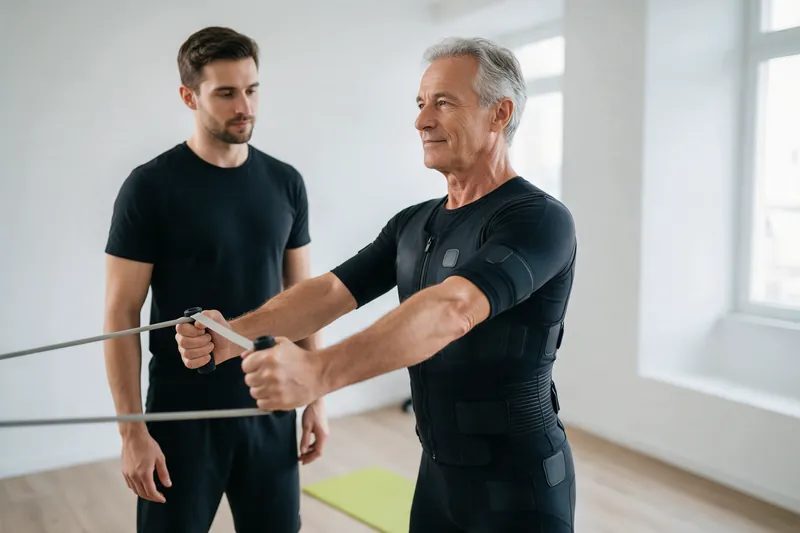
The main risk: too much, too soon
EMS can work a very large muscle mass harder than you could voluntarily. If the first session is too intense, muscle fibres break down and release creatine kinase (CK) into the blood. After a first exhaustive session, CK values from 1,000 up to 240,000 U/L have been reported, peaking three to four days later.[1] In severe cases this is rhabdomyolysis, which can damage the kidneys. Case reports include two professional footballers[2] and a patient hospitalised after a single 25-minute session.[3] A review found nine cases, “preferentially after the first application”.[4]
The reassuring part: the body adapts quickly. After ten weekly sessions, CK responses fall to a fraction of the first-session values.[5]
Warning signs: dark, cola-coloured urine, severe muscle pain or weakness, or swelling in the days after a session. Any of these needs urgent medical attention.
What the expert guideline says
The 2023 international guideline sets out these rules:[5]
- For the first 8 to 10 weeks, no more than one 20-minute session a week.
- First sessions: about 5 minutes of getting used to the impulse, then about 12 minutes of intermittent stimulation.
- Start at a moderate effort, about 4 on a 10-point scale, and rise to 7 or 8 only after 8 to 10 sessions. Never train to exhaustion.
- After that, leave at least four days between intense sessions.
- Drink 250 to 500 ml of water before and after training.
The uncomfortable part for home suits
We sell you nothing by hiding this: the same guideline states, “we thus strictly advise against un- or remotely-supervised application of WB-EMS without the guidance of a licensed trainer.”[5] Home suits exist anyway, and the FDA has cleared some of them for consumer use. If you train at home, we think the responsible approach is this:
- Have your first sessions with a qualified trainer, in person or by video.
- Follow the build-up schedule above exactly, whatever the app or the brand’s FAQ suggests.
- Prefer systems that limit intensity or weekly training time for home users. Visionbody’s home system, for example, caps training at 120 minutes a week and at 75% of its Pro output.
- Never train alone if you feel unwell.
Be wary of brands that recommend training three or four times a week. That advice conflicts with the guideline.
Who should not use EMS
A German expert consensus revised the contraindications in 2024.[6]
Absolute: do not train
- Pregnancy
- Pacemakers and other electric implants
- Heart arrhythmia
- Epilepsy and neurological diseases
- Acute illness, bacterial infection, inflammation
- Recent operations in the stimulated areas
- Arteriosclerosis, arterial circulation disorders
- Stents or bypasses fitted less than 6 months ago
- Untreated high blood pressure
- Severe bleeding disorders such as haemophilia
- Abdominal wall or inguinal hernia
- Under the influence of alcohol or drugs
Relative: medical clearance first
- Diabetes mellitus
- Tumour and cancer
- Cardiovascular diseases
- Acute back pain without diagnosis, herniated discs
- Implants older than 6 months
- Diseases of internal organs, especially kidney disease
- Major fluid retention
- Open wounds, eczema or burns near electrodes
- Medication for any of these conditions
What regulators say
The FDA regulates EMS devices and reports that it has received reports of “shocks, burns, bruising, skin irritation, and pain”, as well as interference with pacemakers and defibrillators.[7] A device with a 510(k) clearance has at least shown the FDA its electrical safety data. See which suits have one in our FDA guide.
In Germany, commercial EMS is regulated by the NiSV ordinance, which requires proven expertise from anyone applying EMS to clients. It does not apply to private home use.[8] The studio standard DIN 33961-5 covers how studios should operate.[9]
Frequently asked questions
Can EMS training damage your muscles?
A first session that is too intense can cause severe muscle breakdown, in rare cases rhabdomyolysis. Building up slowly over 8 to 10 weeks almost eliminates the risk.
Can I use an EMS suit with a pacemaker?
No. Pacemakers and other electric implants are an absolute contraindication.
Can I use an EMS suit during pregnancy?
No. Pregnancy is an absolute contraindication in the expert consensus.
Sources
- Teschler M, Mooren FC (2019). (Whole-body) electromyostimulation, muscle damage, and immune system: a mini review. Frontiers in Physiology 10:1461 – doi.org/10.3389/fphys.2019.01461
- Kästner A, Braun M, Meyer T (2015). Two cases of rhabdomyolysis after training with electromyostimulation by 2 young male professional soccer players. Clinical Journal of Sport Medicine 25(6):e71-3 – doi.org/10.1097/jsm.0000000000000153
- Mallek W, Kechida M, Jellad A (2025). Electromyostimulation-induced rhabdomyolysis: a case report and comprehensive literature review. Cureus 17(10):e95125 – doi.org/10.7759/cureus.95125
- Stöllberger C, Finsterer J (2019). Side effects of whole-body electro-myo-stimulation. Wiener Medizinische Wochenschrift 169(7-8):173-180 – doi.org/10.1007/s10354-018-0655-x
- Kemmler W, et al. (2023). Position statement and updated international guideline for safe and effective whole-body electromyostimulation training. Frontiers in Physiology 14:1174103 – doi.org/10.3389/fphys.2023.1174103
- von Stengel S, et al. (2024). Revised contraindications for the use of non-medical WB-electromyostimulation. Evidence-based German consensus recommendations. Frontiers in Sports and Active Living 6:1371723 – doi.org/10.3389/fspor.2024.1371723
- U.S. Food and Drug Administration. Electronic Muscle Stimulators (consumer information) – www.fda.gov/medical-devices/consumer-products/electronic-muscle-stimul
- Bundesamt für Strahlenschutz. NiSV ordinance on protection against non-ionising radiation in applications on humans – www.bfs.de/DE/bfs/gesetze-regelungen/nisv/nisv.html
- DIN 33961-5:2023-09. Fitness club: requirements for equipment and operation, part 5: electromyostimulation training – www.dinmedia.de/en/standard/din-33961-5/367819654