
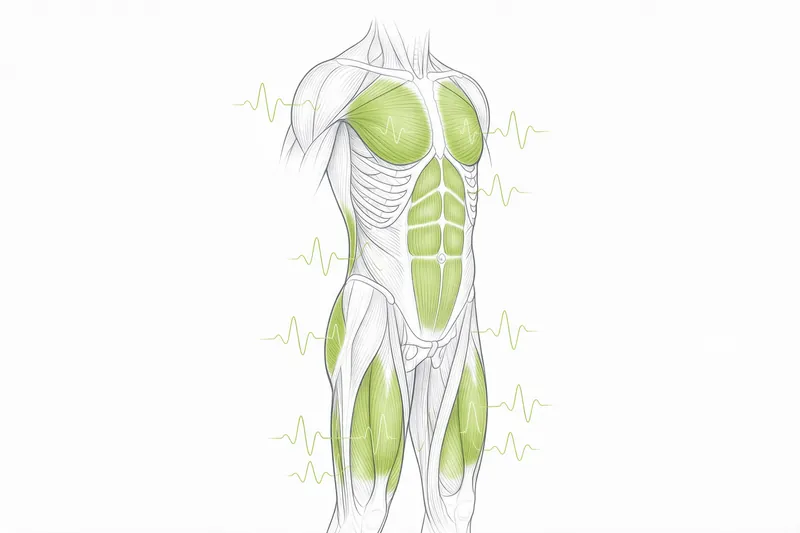
Your muscles already run on electricity
When you decide to lift something, your brain sends an electrical signal down a motor nerve, and the muscle fibres connected to that nerve contract. Electrical muscle stimulation, or EMS, produces a similar signal from outside. Electrodes on the skin pass a small current that triggers the motor nerve, and the muscle contracts without a command from the brain.[1]
How that differs from voluntary training
In normal training your body recruits muscle fibres in order, small ones first and the large, powerful ones only when the load is high. Electrical stimulation does not follow that order. It recruits fibres in a “nonselective, spatially fixed, and temporally synchronous pattern”.[2] That is why EMS can reach fibres you would otherwise only use under heavy load, and also why it tires muscles quickly.
A whole-body suit applies this to all major muscle groups at the same time, with a separate intensity setting for each pair of electrodes. The stimulated area can reach about 2,800 cm².[3][4] Sessions are combined with light movements such as squats and lunges.
The four numbers that define a session
| Parameter | What it means | Typical value in trials |
|---|---|---|
| Frequency | Pulses per second, in hertz. Higher frequencies produce stronger, smoother contractions. | 85 Hz |
| Pulse width | How long each pulse lasts, in microseconds. Wider pulses reach deeper. | 350 µs |
| Duty cycle | The rhythm of stimulation and rest. | 4–6 s on, 4 s off |
| Session length | Total training time. | About 20 minutes, 1 to 1.5 times a week |
These values come from the protocol used in most of the German trials that make up the evidence base.[5] A review of 89 trials of mostly local EMS found that strength gains depended on a stimulation intensity of at least 50% of maximal voluntary contraction.[6] When you compare suits, check that the published range covers these values. Visionbody, for example, lists 4 to 100 Hz and 150 to 500 µs in its FDA summary. Several brands publish no range at all.
Channels and electrodes are not the same thing
An electrode is a contact surface. A channel is an independently controlled output. Two electrodes usually share one channel. More channels mean you can set, say, your lower back and your abdomen separately. When a brand advertises “20 electrodes”, ask how many channels drive them.
Why 20 minutes is enough, and why more is risky
Because a very large muscle mass is stimulated at once, and because the current can push muscles beyond what voluntary effort allows, the load on the body is high.[3] That is what makes EMS time-efficient. It is also why the first sessions must be gentle. Read the safety guide before you start.
Frequently asked questions
What frequency is best for EMS training?
Most published whole-body EMS trials used 85 Hz with a pulse width of 350 microseconds, 4 to 6 seconds of stimulation followed by 4 seconds of rest.
Does EMS training hurt?
It should not. You feel a strong tingling and a firm contraction. Intensity is set per muscle group, and guidelines recommend starting at a moderate effort of about 4 on a 10-point scale.
Sources
- Maffiuletti NA (2010). Physiological and methodological considerations for the use of neuromuscular electrical stimulation. European Journal of Applied Physiology 110(2):223-234 – doi.org/10.1007/s00421-010-1502-y
- Gregory CM, Bickel CS (2005). Recruitment patterns in human skeletal muscle during electrical stimulation. Physical Therapy 85(4):358-364 – doi.org/10.1093/ptj/85.4.358
- Teschler M, Mooren FC (2019). (Whole-body) electromyostimulation, muscle damage, and immune system: a mini review. Frontiers in Physiology 10:1461 – doi.org/10.3389/fphys.2019.01461
- Kemmler W, et al. (2023). Position statement and updated international guideline for safe and effective whole-body electromyostimulation training. Frontiers in Physiology 14:1174103 – doi.org/10.3389/fphys.2023.1174103
- Kemmler W, et al. (2016). Effects of whole-body electromyostimulation versus high-intensity resistance exercise on body composition and strength: a randomized controlled study. Evidence-Based Complementary and Alternative Medicine 2016:9236809 – doi.org/10.1155/2016/9236809
- Filipovic A, et al. (2011). Electromyostimulation: a systematic review of the influence of training regimens and stimulation parameters on effectiveness. Journal of Strength and Conditioning Research 25(11):3218-3238 – doi.org/10.1519/jsc.0b013e318212e3ce