
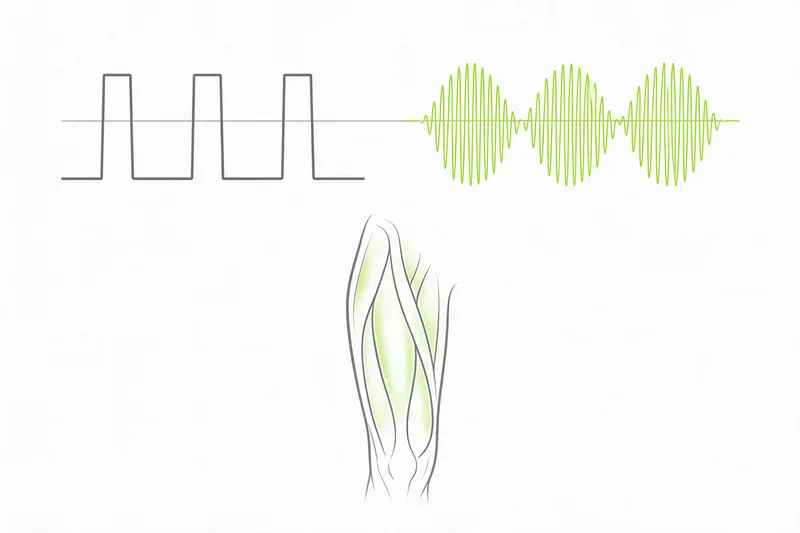
Two kinds of current
Low frequency means separate pulses, usually between 1 and 150 per second. Each pulse triggers the motor nerve, and at around 85 pulses a second the muscle holds a smooth, strong contraction. This is the current used in nearly all whole-body EMS research.
Medium frequency works differently. The device sends an alternating current of several thousand hertz, a so-called carrier, and switches or modulates it in a slow rhythm. The nerve cannot follow thousands of cycles a second, so the muscle responds to the slow rhythm, not to the carrier. Physiotherapy has used such currents since the 1950s, first as interferential current and later as “Russian current” for muscle strengthening.[1][2]
What you actually feel
The two currents do not feel the same, and this is the part you can judge for yourself.
- Low frequency is felt as distinct pulses. At low rates it is a tapping, at training rates a firm, gripping contraction with a clear prickle at the skin, especially where the skin is thin.
- Medium frequency is felt as a fine, dense buzzing that spreads more evenly under the electrode, because the individual cycles are far too fast to feel one by one.
There is a physical reason for the difference at the skin. Skin behaves partly like a capacitor, so its resistance falls as frequency rises. That is why kilohertz currents were introduced in the first place.[1] A laboratory study that tested 20 carrier frequencies between 1 and 35 kHz found that sensory, motor and pain thresholds all fell as frequency rose towards 10 kHz, and that the gap between “I can feel it” and “it hurts” widened with frequency. The authors concluded: “For comfortable sensory stimulation, a high frequency of alternating current is preferable.”[3]
Why having both is the real advantage
How a current feels is personal. It depends on your skin, your body fat, the muscle group and how used you are to EMS. Some people tolerate low-frequency pulses well everywhere. Others find them sharp on the abdomen, the inner arms or the inner thighs, and ease off before the muscle has worked properly. If a suit offers only one kind of current, that is the end of the story.
A system with both gives you, and your trainer, a second tool. You can use low frequency where you want the classic strong contraction that the research is built on, and medium frequency where the finer sensation lets you train a sensitive area at all, or where you want a different stimulus for warming up and recovery. For a product you will use for years, that flexibility is worth more than any single number on a spec sheet.
What the evidence says, and what it does not
Two systematic reviews compared kilohertz alternating current with low-frequency pulsed current on single muscles, mostly the thigh. One found similar evoked force and similar discomfort.[4] The other, covering 15 studies, found equal or less force, similar discomfort at maximal tolerated intensity and more fatigue with kilohertz current, and concluded that the available evidence “does not support the idea that kilohertz-frequency alternated current is better than low-frequency pulsed current for strength training and rehabilitation”.[5] A review of the kilohertz currents used in clinics also concluded that the commonly used settings are not optimal, and that short bursts work best.[1]
Two more limits. Those studies looked at one muscle at a time, not at whole-body suits. And we found no trial comparing low and medium frequency in whole-body EMS. So the honest summary is this: low frequency is the proven workhorse, and medium frequency is a second current with a different feel whose training benefit in a suit has not been measured yet.
Which suits offer it
Among the systems we compare, only VisionBody documents both. Its FDA summary describes a box that “delivers a safe low to mid frequency electrical current”, using what the maker calls EMS and EMA, and the maker lists a low range of 0 to 100 Hz and a medium range of 2,000 to 7,000 Hz. TitanBody publishes 1 to 100 Hz, Katalyst 1 to 105 Hz, miha bodytec 2 to 150 Hz and XBody 1 to 150 Hz. The FDA summaries of Katalyst, miha bodytec, XBody, WiemsPro and E-Fit mention no medium-frequency current, and Pepper, SQAI and OHM publish no frequency range at all.
How to test it yourself
Because the difference is something you feel, test it in a trial session before you buy.
- Pick one muscle group, for example the thighs, and one sensitive one, for example the abdomen.
- Train each with a low-frequency programme at a contraction strength you would call “firm but fine”. Note how the skin feels.
- Switch to a medium-frequency programme and bring the contraction to the same strength. Compare the sensation at the skin and how deep the contraction feels.
- Ask yourself one question: with which current would you still be happy to train this area in week 20?
Follow the safe start plan while you do this. A first session is not the time to test maximum intensity with any current.
Frequently asked questions
What is medium-frequency EMS?
Medium-frequency EMS uses an alternating carrier current of several thousand hertz that is switched or modulated in a slow rhythm. The muscle responds to the slow rhythm. Low-frequency EMS uses separate pulses, usually between 1 and 150 per second.
Is medium-frequency EMS better than low-frequency EMS?
It is not proven to be better for building strength. Systematic reviews of single-muscle studies found similar discomfort and equal or less force compared with low-frequency current. It does feel different, and a laboratory study found that higher carrier frequencies are preferable for comfortable sensory stimulation.
Which EMS suit has medium frequency?
Among the systems we compare, only VisionBody documents both low and medium frequency. Its FDA summary describes a low to mid frequency current, and the maker lists a medium range of 2,000 to 7,000 Hz.
Sources
- Ward AR (2009). Electrical stimulation using kilohertz-frequency alternating current. Physical Therapy 89(2):181-190 – doi.org/10.2522/ptj.20080060
- Ward AR, Shkuratova N (2002). Russian electrical stimulation: the early experiments. Physical Therapy 82(10):1019-1030 – doi.org/10.1093/ptj/82.10.1019
- Ward AR, Robertson VJ (1998). Sensory, motor, and pain thresholds for stimulation with medium frequency alternating current. Archives of Physical Medicine and Rehabilitation 79(3):273-278 – doi.org/10.1016/s0003-9993(98)90006-5
- da Silva VZ, et al. (2015). Current evidence demonstrates similar effects of kilohertz-frequency and low-frequency current on quadriceps evoked torque and discomfort in healthy individuals: a systematic review with meta-analysis. Physiotherapy Theory and Practice 31(8):533-539 – doi.org/10.3109/09593985.2015.1064191
- Vaz MA, Frasson VB (2018). Low-frequency pulsed current versus kilohertz-frequency alternating current: a scoping literature review. Archives of Physical Medicine and Rehabilitation 99(4):792-805 – doi.org/10.1016/j.apmr.2017.12.001
- FDA 510(k) summary K222386, VisionBody – www.accessdata.fda.gov/cdrh_docs/pdf22/K222386.pdf
- VBTec, VB Pro system (frequency ranges) – vbtec.com/vb-pro/