
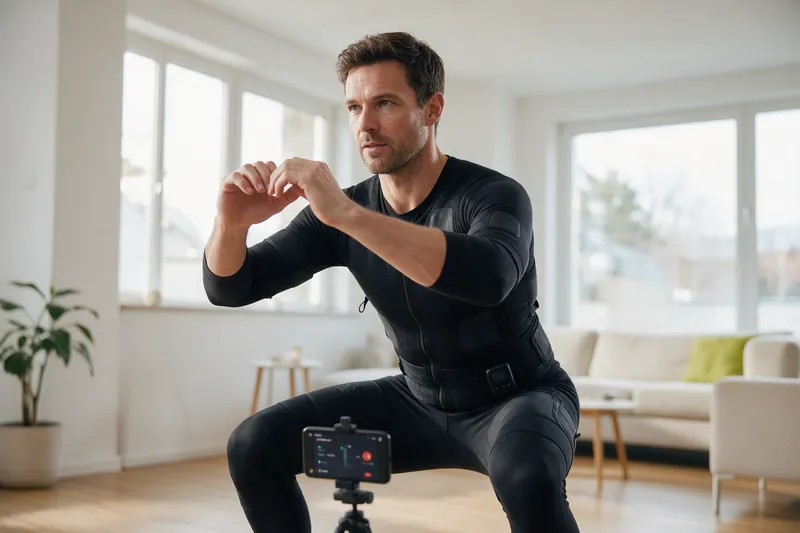
Before your first session
- Get medical clearance if any contraindication could apply to you.
- Be healthy and rested. Never train with a fever, an infection, or after alcohol.
- Eat a light carbohydrate snack about two hours before, and drink 250 to 500 ml of water before and after.[1]
- Know where the stop button is, in the app and on the device.
The plan
| Phase | Sessions | Effort (0–10) | What to do |
|---|---|---|---|
| Sessions 1–2 | One a week | About 4 | About 5 minutes getting used to the impulse, then about 12 minutes of intermittent stimulation with gentle movements. |
| Sessions 3–10 | One a week | Rising from 4 to 7 | Up to 20 minutes. Raise the intensity a little each session, muscle group by muscle group. |
| After 8–10 weeks | At least 4 days apart | Up to 7 or 8 | 20 minutes at most for intense sessions. Never train to complete exhaustion. |
Based on the 2023 international guideline.[1] “Effort” is how hard the session feels overall on a 10-point scale.
How to set intensity
Set each muscle group separately. The contraction should feel strong but never painful, and you should be able to move and speak through it. If a contraction locks the muscle so that you cannot move, it is too high. Large muscles such as the thighs and glutes tolerate more than the arms or abdomen.
What not to do
- Do not train three or four times a week, whatever a brand’s FAQ says. The guideline allows one session a week at the start.
- Do not push to the maximum in the first sessions to “see what it can do”. That is how the serious incidents happened.[2]
- Do not train through unusual pain.
Warning signs afterwards
Normal: muscle soreness for one to three days. Not normal: dark, cola-coloured urine, severe pain or weakness, or swelling. These can signal rhabdomyolysis and need urgent medical attention. More in EMS and rhabdomyolysis.
What helps in a suit
A home mode that limits intensity and weekly training time builds the guideline into the device. VisionBody’s home system, for example, caps training at 120 minutes a week and at 75% of its Pro output. Per-channel control lets you keep sensitive areas low.
Frequently asked questions
How often should beginners do EMS training?
Once a week for the first 8 to 10 weeks, according to the 2023 international guideline. After that, leave at least four days between intense sessions.
How hard should the first EMS session be?
Moderate: about 4 on a 10-point effort scale, with roughly 5 minutes of familiarisation and 12 minutes of intermittent stimulation.
Sources
- Kemmler W, et al. (2023). Position statement and updated international guideline for safe and effective whole-body electromyostimulation training. Frontiers in Physiology 14:1174103 – doi.org/10.3389/fphys.2023.1174103
- Teschler M, Mooren FC (2019). (Whole-body) electromyostimulation, muscle damage, and immune system: a mini review. Frontiers in Physiology 10:1461 – doi.org/10.3389/fphys.2019.01461