
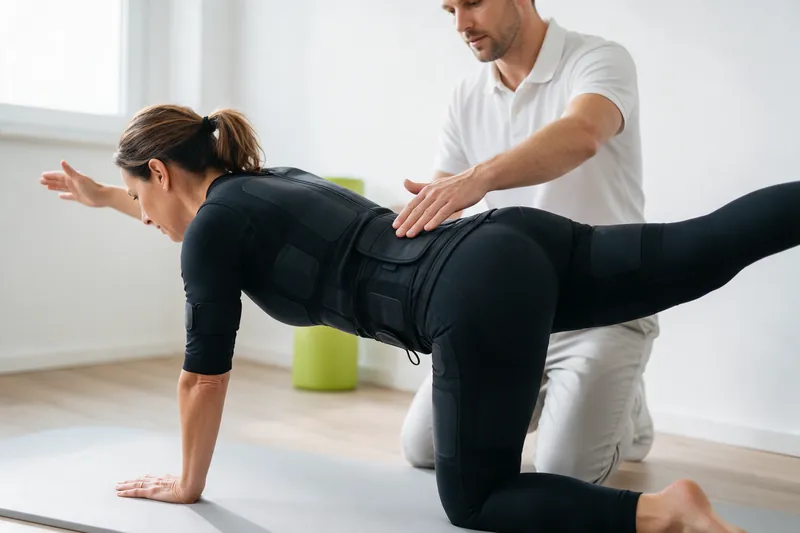
What the randomised trials show
Against doing nothing. In a trial of 30 patients, one 20-minute session a week for 12 weeks reduced pain significantly compared with a passive control group.[1]
Against conventional back training. In 110 patients, pain fell by 22.3% with whole-body EMS and by 30.2% with a recognised back-strengthening programme. The difference between the groups was not statistically significant.[2]
Three methods compared. A trial of 240 patients compared EMS, whole-body vibration and conventional back training. All three reduced pain by about 30%, and trunk strength improved in all groups. The EMS group needed 43 to 62% less training time.[3]
Pooled data. A meta-analysis of individual patient data from adults aged 60 and over found significant effects on back pain,[4] and a 2025 systematic review and meta-analysis reached a positive conclusion for low-frequency whole-body EMS in chronic non-specific back pain.[5]
Why it might work
Much chronic low back pain is linked to weak, poorly coordinated trunk muscles. EMS activates the deep and superficial trunk muscles together, including muscles that people with back pain often find hard to engage voluntarily. It does this without heavy loads on the spine.
The limits
- All trials used supervised sessions on studio devices. None tested a home suit.
- All used low-frequency stimulation, typically 85 Hz. Nothing is known about mid-frequency systems for back pain.
- EMS was no better than conventional back training. Its advantage is time, not effect size.
- Follow-up periods were short, so long-term effects are unknown.
What this means in practice
If you have diagnosed chronic low back pain and struggle to keep up conventional exercise, weekly EMS is a reasonable, evidence-based option. Start with a physiotherapist or a qualified trainer. If you then move to a home suit, choose one that lets you set the lower back and abdominal channels separately and that publishes a frequency range covering 85 Hz. Our ranking shows which suits do.
Frequently asked questions
Does EMS help lower back pain?
In randomised trials, weekly 20-minute whole-body EMS sessions reduced chronic non-specific low back pain by about 20 to 30%, similar to conventional back training.
Can I use an EMS suit with a herniated disc?
Herniated discs and acute back pain without a diagnosis are relative contraindications. Get medical clearance first.
Sources
- Weissenfels A, et al. (2018). Effects of whole-body electromyostimulation on chronic nonspecific low back pain in adults: a randomized controlled study. Journal of Pain Research 11:1949-1957 – doi.org/10.2147/jpr.s164904
- Weissenfels A, et al. (2019). Comparison of whole-body electromyostimulation versus recognized back-strengthening exercise training on chronic nonspecific low back pain. BioMed Research International 2019:5745409 – doi.org/10.1155/2019/5745409
- Micke F, et al. (2021). Similar pain intensity reductions and trunk strength improvements following whole-body electromyostimulation vs. whole-body vibration vs. conventional back-strengthening training. Frontiers in Physiology 12:664991 – doi.org/10.3389/fphys.2021.664991
- Kemmler W, et al. (2017). Effects of whole-body electromyostimulation on low back pain in people with chronic unspecific dorsal pain: a meta-analysis of individual patient data from randomized controlled WB-EMS trials. Evidence-Based Complementary and Alternative Medicine 2017:8480429 – doi.org/10.1155/2017/8480429
- Konrad KL, et al. (2025). Low-frequency whole-body electromyostimulation (WB-EMS) for nonspecific chronic back pain: a systematic review and meta-analysis. Cureus 17(7):e88462 – doi.org/10.7759/cureus.88462
- von Stengel S, et al. (2024). Revised contraindications for the use of non-medical WB-electromyostimulation. Evidence-based German consensus recommendations. Frontiers in Sports and Active Living 6:1371723 – doi.org/10.3389/fspor.2024.1371723